Plaza de la Intendencia
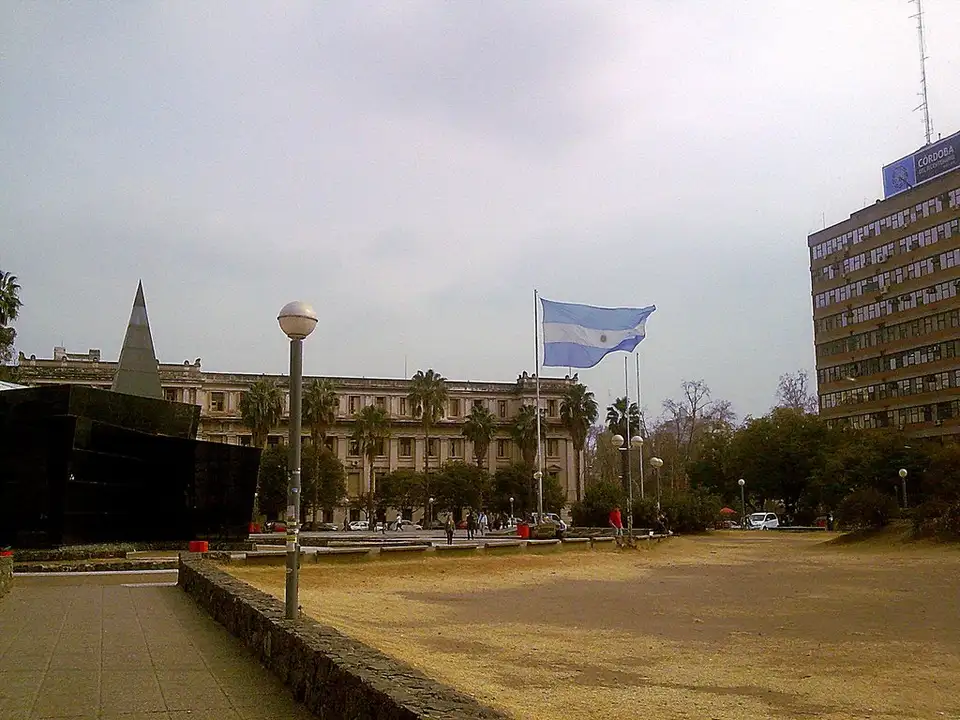
Located in the central core of Córdoba Capital, Plaza de la Intendencia – Héroes de Malvinas serves as a green lung and key gathering point amid the city’s urban activity. Situated alongside the historic route of La Cañada and connected by a pedestrian zone to Paseo Sobremonte, this space offers a moment of calm in one of the city’s busiest areas. Its significance is not only recreational but also symbolic, as it weaves elements of Argentina’s collective memory into the everyday landscape of the city center — a connection reinforced by its recent official name.
Memory and heritage in public space
One of the plaza’s most distinctive features is its commemorative value. At the intersection of Duarte Quirós and Marcelo T. de Alvear stands the monument “Héroes de Malvinas”, a work by Córdoba artist Marcelo Hepp. Inaugurated in 1983, the monument is built in cement and depicts seven soldier figures without military rank. The composition includes three soldiers at the front holding the Flag, representing the three armed forces: the Army, the Navy, and the Air Force. The work commemorates the soldiers who fell in the 1982 war and stands as a visual landmark that defines the solemn character of this section of the plaza.
A space for culture and gathering
Beyond its historical weight, the plaza has infrastructure designed for social and cultural life. At its center stands a glass building that functions as the “Casa del Futuro” (House of the Future), a space designed to host exhibitions, artistic and musical presentations, as well as workshops and training sessions aimed at young people. This component transforms the site into a hub of educational and artistic activity that goes beyond the simple use of an urban park.
The surroundings are completed by rest areas and children’s play sections, making the plaza a destination for families and passersby looking for a break during their time in the city center. The structure also includes a significant underground level used as a car park — a technical solution that was a fundamental part of the original 1983 design, intended to ease the vehicle circulation problems affecting the area following increased traffic near the Palacio Municipal.
Connection with the urban fabric
The plaza integrates fully into the city’s urban fabric through its proximity to landmarks such as La Cañada and its boundaries along streets including Caseros, Duarte Quirós, and Bolívar. Its design responds to a historical need to organize vehicle flow in a sector that experienced chaotic dynamics before its inauguration. Today, this space consolidates as a point where recent national history, youth culture, and the need for green areas converge on the same urban plane.