Palacio 6 De Julio Municipalidad De Cordoba
The Palacio 6 de Julio serves as the central headquarters of the Municipalidad de Córdoba. Located at a strategic point in the provincial capital, this building is not merely an administrative management centre — it is also an architectural landmark that marks a departure from the city’s traditionalist style. Its presence in Córdoba’s urban fabric positions it as a reference point for the modern development of the mid-twentieth century.
Architecture and brutalist language
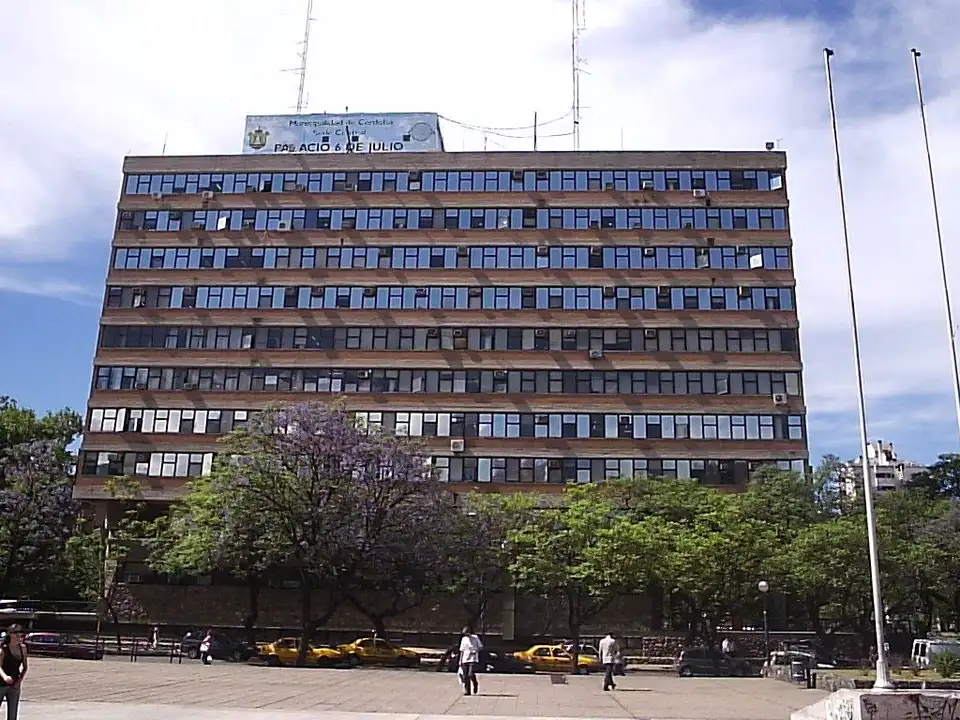
The building is a notable example of brutalist architecture, a style that moved away from the neoclassical forms that once prevailed in Córdoba. Originally built in 1953 by the SEPRA studio, its structure presents a vanguard morphology for the era. The complex is organised around two distinct volumes that enter into dialogue with one another.
The first volume has a markedly administrative character and takes the form of an eight-storey prism. This block is raised above the ground floor, supported on columns with an inverted V shape. Exposed concrete is the central element of its aesthetic, generating the gravitational tension characteristic of brutalism. Complementing this structure are suspended brise-soleils on the elevations, also made of exposed concrete, which lend a grid-like rhythm to the façade.
The second volume, known as the Edificio Ejecutivo, presents a modern architecture with more classical proportions, providing a visual balance within the complex.
Recovery of public space and heritage
In recent years, the Palacio has been the subject of renovation projects aimed at restoring the relationship between the municipal building and the community. One of the main focuses of these interventions was the recovery of the ground floor, which had historically been occupied by various municipal departments, limiting the free movement of citizens.
The recovery plan sought to free this area and return it to its public character, allowing for more natural circulation and greater integration with the urban surroundings. These actions are complemented by lighting projects designed to revalue both the façade and the building’s architectural heritage. The lighting serves not only a technical function but also acts as a tool to highlight the original architectural gestures, the concrete elements, and the movement flows envisioned in the original design.
This process of revaluation allows the Palacio 6 de Julio to be understood not merely as an office block, but as an element of dialogue between municipal governance and urban space — underscoring the importance of its materials and structural composition within the landscape of Córdoba.