Saint Christopher Ship
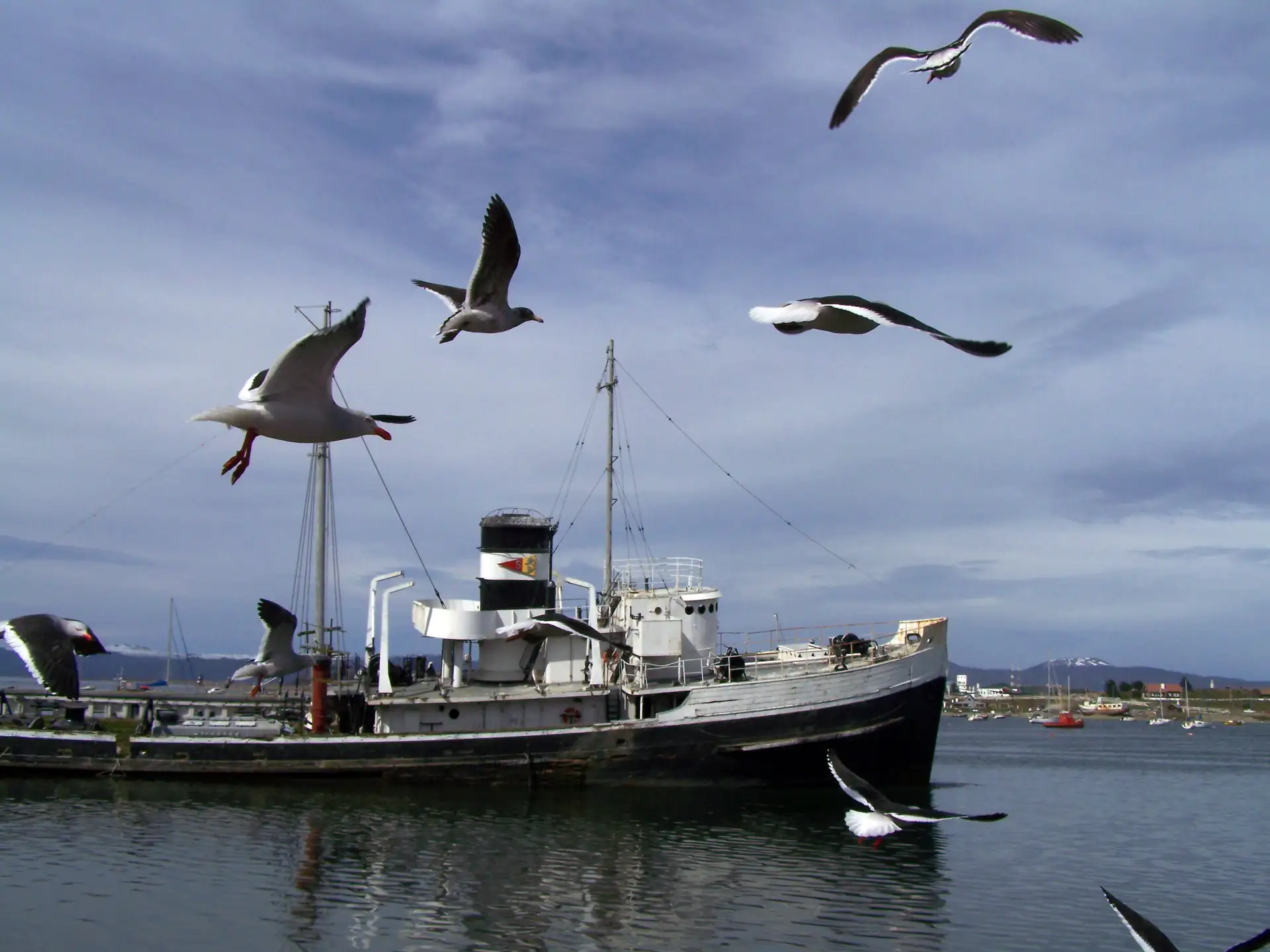
In the bay of Ushuaia, a metal structure rising from the water marks an immediate landmark for anyone travelling along the coast of the world’s southernmost city. The Saint Christopher is a grounded vessel that has become part of the urban and coastal landscape of the area, turning into a distinctive element of Ushuaia’s visual identity. Its physical presence — static and enduring along the shoreline — makes it a point of interest for those passing along Avenida Prefectura Naval Argentina.
History and origins of the vessel
The Saint Christopher’s history dates back to the 1940s, with construction rooted in shipyards in the United States. It was built at the Camden Shipbuilding & Marine Railway Company in Maine, under the firm John D. Alden Eldrefge-Mclnnis. Its original technical specifications include a length of 50.29 metres, with propulsion systems by Fulton Ironworks and boilers supplied by the Babcock & Wilcox Company.
Its operational history began in October 1943, spanning periods of significant geopolitical importance. In 1944, after being transferred to the United Kingdom, the vessel was incorporated into the Royal Navy under the name HMS Justice (W-140). After decades of navigation and service, its final destination brought it to the waters of Tierra del Fuego, where it ran aground approximately 65 years ago, shifting its role from active vessel to an element of local visual heritage.
Presence in the Fuegian landscape
The ship is not merely an abandoned structure — it is also the subject of conservation and maintenance efforts involving various local institutions. The Prefectura Naval Argentina, together with the Secretaría de Turismo of the Municipality of Ushuaia, has taken part in technical inspections to monitor the vessel’s condition. These interventions aim to manage its presence in the bay within the framework of policies for the care of the urban and coastal environment.
For those exploring the area, the Saint Christopher offers a contrast between twentieth-century naval engineering and the natural surroundings of the bay. Its silhouette, visible from various points along the coast, allows the scale of historic shipbuilding to be appreciated in relation to the Fuegian landscape. As a feature that can be seen from public thoroughfares, it integrates naturally into walks through the port and coastal areas of the city.