Civic Center of the Province of Córdoba
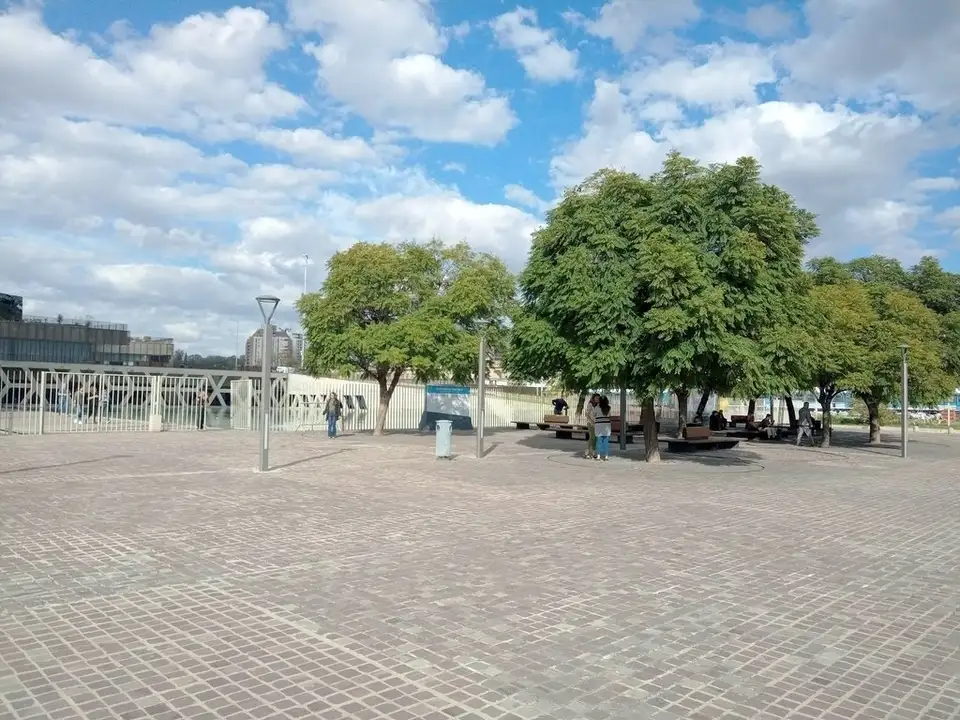
The Civic Center of the Province of Córdoba sits at a strategic point in the city’s downtown core, occupying land that previously served as railway marshalling yards. This complex is not merely an administrative headquarters but the nucleus of a broader urban operation aimed at transforming the relationship between the city and its natural surroundings. The project forms part of a restoration plan for the Río Suquía, functioning as a node that seeks to ease the historical separation that the river’s abandonment and railway barriers imposed between the center and the traditional, densely populated neighborhoods of the area.
Architecture and urban landscape
The composition of the complex is defined by the contrast between two main volumes. The taller building presents robust proportions and a perforated concrete structure that employs an Arab tessellation pattern. This technique, based on a rhomboidal design, creates a faceted prism with alternating slopes that produce plays of light and shadow depending on the position of the sun. The grid of perforations functions as a self-compacting concrete sunshade, aiding interior climate conditioning by generating shade microclimates.
Opposite this volume stands a single-story building with a markedly horizontal layout. This structure features glazed façades shielded by expanded metal systems and linear planters supporting deciduous climbing plants. The proposal seeks to integrate vegetation into the very skin of the building, complemented by a green roof that includes grass sections and flowering areas.
The reflecting pool and territorial connection
A central element linking both buildings is a large, shallow reflecting pool. This component serves not only an aesthetic function by mirroring the architectural structures but also acts as an alternative fire reserve for the complex. A fundamental design detail is its capacity for transformation: during public events or gatherings, the pool can be drained to become a large civic plaza, expanding the meeting space available to residents.
The integration with the surroundings is completed by a double bridge that crosses the area. The lower sections of this structure are designed to be covered by native climbing plants, reinforcing the river’s landscape restoration strategy. In this way, the architecture seeks not to compete with the future scale of the urban environment, but to present itself as an accessible administration and an integral part of the urban fabric, facilitating movement between the center and the sectors that were previously segregated by railway infrastructure.