Buenos Aires Long-Distance Bus Terminal
The Buenos Aires Long-Distance Bus Terminal functions as the central hub for overland transport for those travelling from the Autonomous City to the various points of Argentine territory. Strategically located in the Retiro area, near the intersection of Avenida Antártida Argentina and Calle 10, this infrastructure is a fundamental convergence point for the flow of passengers connecting the capital with the interior provinces.
A regional connectivity axis
Beyond its role as a transport terminal, this space represents a key element in the region’s mobility dynamics. Its importance lies in its capacity to coordinate long-distance routes, enabling access to various regions of the country through a network of services that links the capital with the most remote destinations. The structure sits within a high-density urban environment, where transit activity and passenger logistics define the daily rhythm of the area.
The terminal acts as a transition point between the metropolitan dynamics of Buenos Aires and the routes that extend toward the rest of Argentina. As a large-scale hub, its presence is decisive for understanding how the movement of people is organised across the greater urban area and toward the country’s peripheral zones. The terminal serves not only as a departure or arrival point, but as a space where urban infrastructure meets the need for national connectivity.
Urban context and mobility
The surroundings of the station are defined by their proximity to other transport and commercial nerve centres in the Retiro area. This location allows the terminal to form part of an integrated system where different modes of travel converge, facilitating the transition between local services and interprovincial routes. The scale of the place reflects the importance of Buenos Aires as the nation’s administrative and logistical centre.
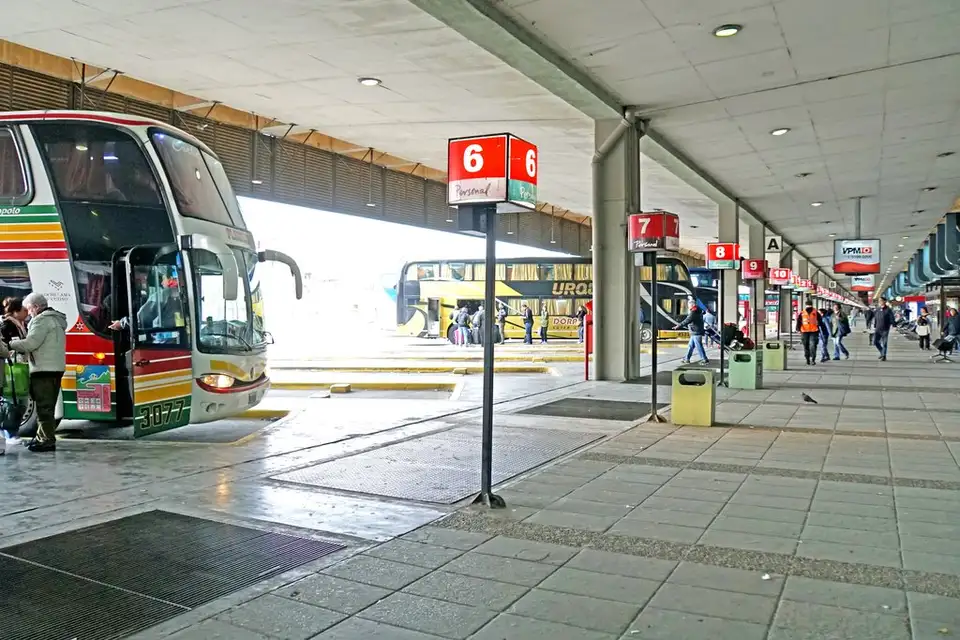
The experience in this space is tied to the constant movement of travellers and the flow of coaches operating toward different geographic points. It is a place characterised by its functional nature, where the architecture and spatial organisation are oriented toward managing the mass flow of people. The terminal remains an essential piece of Argentina’s overland transport infrastructure, sustaining the vital connection between the capital and the country’s diverse regions.