Biblioteca Ricardo Güiraldes
Located on the boundary between the Recoleta and Retiro neighborhoods, the Biblioteca Ricardo Güiraldes presents itself as a refuge of quiet and culture amid the dynamism of Buenos Aires. What today functions as a public library was originally the private residence of the Helguera-Padilla family. This building not only houses bibliographic collections but also stands as an architectural testament to the luxury residential expansion that characterized this area of Buenos Aires.
Architecture and historic heritage
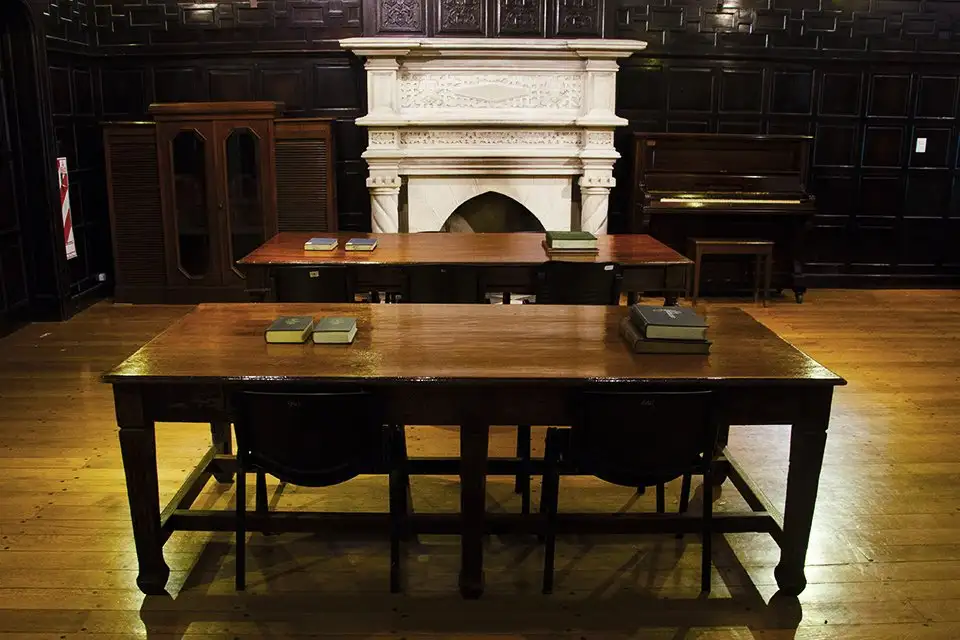
The structure is distinguished by its imposing Tudor style, an aesthetic choice that gives it a distinctive character within the city’s urban landscape. With a floor area exceeding 500 square meters, the building retains elements that evoke its past as a manor house. A tour of its rooms reveals construction details of considerable value, including ornate stained-glass windows and stone fireplaces that lend a solemn atmosphere to the space.
The building is organized across a basement, ground floor, and three upper levels with mezzanines. This layout not only optimizes the use of shelving space but also allows for a fluid transition between reading areas and spaces for contemplation. A central feature of its design is the Andalusian courtyard, which, together with a large garden, has been transformed into a reading patio and amphitheater, integrating the architecture with open areas for cultural gathering.
A node of literary memory
The significance of this space extends beyond its book-lending function, as it is embedded in a circuit of memory connected to the most relevant figures of Argentine literature. The library is part of a network of places that evoke the presence of authors such as Jorge Luis Borges, Adolfo Bioy Casares, and Silvina Ocampo, who lived in or passed through these same streets of Retiro and Recoleta.
Visiting this place means wandering through corners that bear the imprint of the written tradition. The connection with the immediate surroundings is profound: the library acts as an anchoring point in an area where historic residences and buildings designed by renowned architects — such as Alejandro Bustillo — form a setting of constant dialogue between history and contemporary urban life. The space thus serves as a link between the private heritage of the past and public access to knowledge in the present.