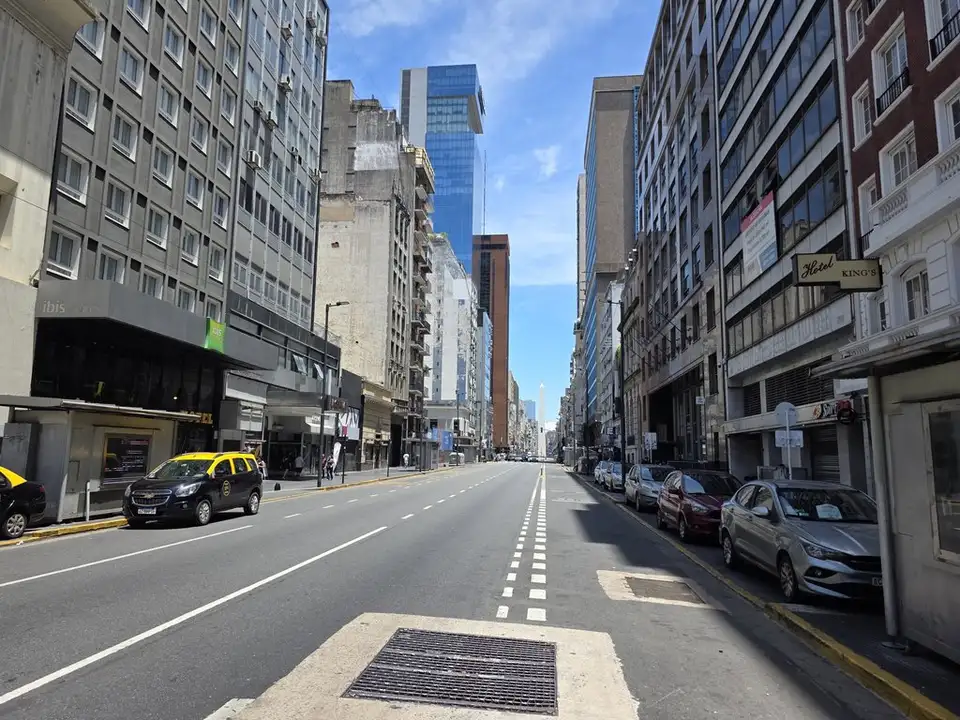
Avenida Corrientes
An articulating axis of the city
Avenida Corrientes functions as one of the main and most extensive thoroughfares in the Ciudad Autónoma de Buenos Aires. Its route crosses through a wide variety of neighborhoods, acting as a vital connector between different areas of the capital. As one travels along it, it becomes clear how its character transforms depending on the section being traversed, integrating areas that range from the Microcentro to more outlying parts of the city.
Its importance lies in its capacity to link various key nodes of the urban fabric. The avenue is not merely a transit route, but a structural element that defines the dynamics of the neighborhoods it passes through. In areas such as Balvanera, its presence is decisive in organizing public space and local circulation.
The stretch through Balvanera
In the neighborhood of Balvanera, the avenue presents specific segments that mark the morphology of the area. For example, its path can be traced from around number 1800, where it crosses Avenida Entre Ríos, through to number 3000 at its intersection with calle Sánchez de Bustamante. These reference points help convey the scale and extent the avenue occupies within this sector of the city.
This segment of the avenue sits within a high-density urban setting, where cross streets such as Chile, México, and Venezuela interact with its constant flow. The structure of Corrientes in Balvanera forms a fundamental part of the framework that sustains activity in this neighborhood, connecting commercial and residential zones with the rest of the city’s urban grid.
Connectivity and territory
The avenue extends well beyond the boundaries of Balvanera, crossing through other neighborhoods including San Nicolás, Once, Villa Crespo, Almagro, and Chacarita. This capacity to traverse multiple internal jurisdictions makes it an element of territorial cohesion within the Ciudad Autónoma. Its longitudinal route allows a fluid transition between the denser zones of the center and the areas that spread toward the north and west.
As such a broad axis, its presence directly influences the configuration of adjacent streets and the logic of movement throughout the city. The avenue not only delineates spaces but integrates them, allowing the identity of each neighborhood to manifest along its length, while always maintaining a structural continuity that is characteristic of Buenos Aires’ urban design.