End of the World Train
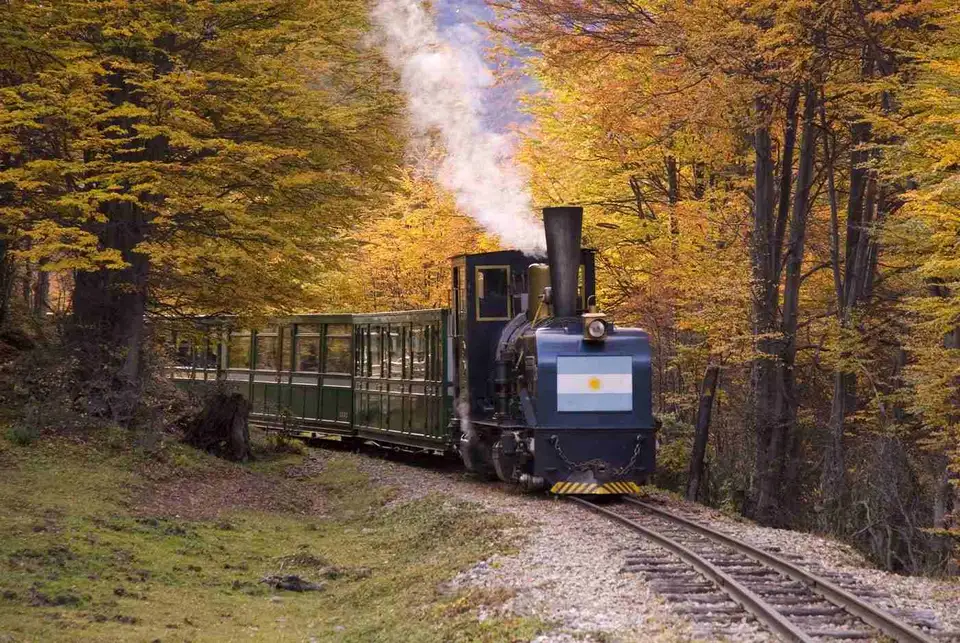
The End of the World Train is one of Ushuaia’s most distinctive railway experiences because it revives part of the track historically used by prison labor to move resources out of town. The operator presents it as a 365-day experience and an official destination visit centered on rail heritage and nature. A practical first frame is that it transforms a complex local history into a guided journey, with multiple stops between the city and the park boundary.
The current operation returned to this past in 1994 after decades of inactivity. According to the official site, the original line started from the Ushuaia prison and headed toward the Susana Mountain slope to source materials such as wood and stone for construction. Today the experience is anchored in its most illustrative segments: stations, valley views, and historical references about forced labor and daily life connected to the railway.
Fin del Mundo Station, around 7 km from the city, functions as the main departure point. It does more than start the trip: it sets the narrative of who rode the line, why it existed, and how it influenced local economic life. The route also crosses Puente Quemado over the Cañadón del Toro and the Pipo River, where remnants of the old wooden bridge remain visible beneath the newer tracks. This blending of new infrastructure and earlier remains creates a material reading of continuity through time.
A key stop is La Macarena Station. In the operator’s own narrative it was a historic point where the steam locomotive La Coqueta was supplied with water. The stop also includes a viewpoint over the Pipo River Valley, Cerro Guanaco, Cerro la Portada, and Monte Susana, and it connects to the source of La Macarena waterfall in the Le Martial range. That tie between scenery and technical history gives the excursion unusual depth for a short visit.
From there the route approaches the boundary of Tierra del Fuego National Park and moves inward. The site attributes the park’s creation to 1960, a 63,000-hectare area, and a character that combines coast, forest, and mountains. This helps explain why the ride changes noticeably within a compact distance. The interpretation includes geographic, flora, and fauna context through guides and onboard audio, which is useful for travelers with limited time.
Midway comes the Tree Cemetery. It highlights cut stumps, remnants of sawmill activity, and how the forest was used to supply firewood to the town. The site also references turbal, a compacted organic-mineral soil typical of Tierra del Fuego, which connects the route to regional ecology beyond scenic description.
The Park Station is the final stop, and in the summer season some visitors can disembark to walk in the park and return on the last train of the day, subject to availability. The official text also notes that park admission is not included in the train price, so it needs to be arranged separately. Service formats include tourist, premium, VIP, and charter options, and the cars have onboard audio in multiple languages.
The locomotive section profiles five historic and support locomotives with varied technical origins, including restored or adapted steam and diesel units. This adds an identity layer: this is not only a scenic outing but also a living interpretation of how railway technology, geography, and community memory intersect in Ushuaia.