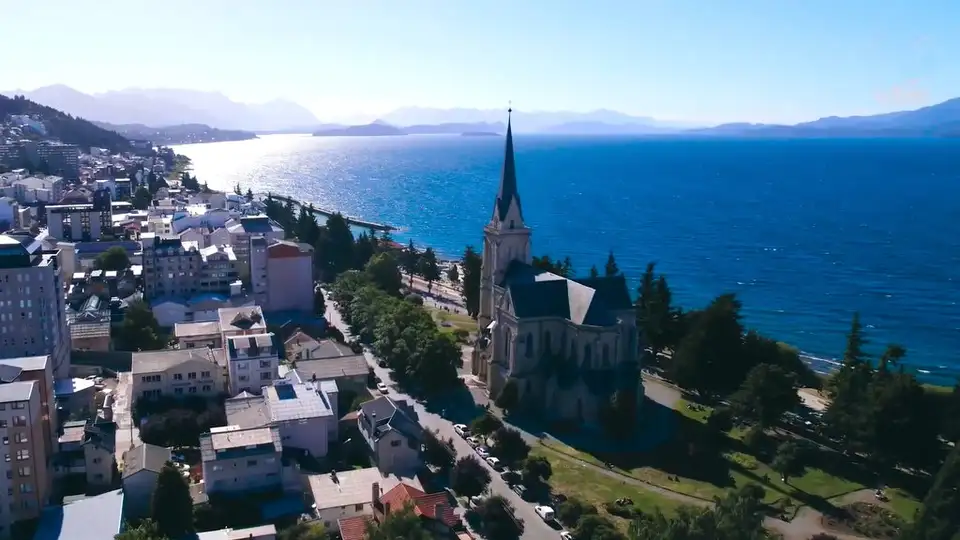
Cathedral of Our Lady of Nahuel Huapi
The Cathedral of Our Lady of Nahuel Huapi stands as the main Catholic church in San Carlos de Bariloche. Located in a central position within the urban grid, it serves as a fundamental point of reference for the religious and cultural identity of the region. The building is not only a place of worship belonging to the Diocese of Bariloche, but also a testament to the city’s architectural development, integrated into the urban landscape through a layout that engages with the surrounding public spaces.
Architecture and Neo-Gothic design
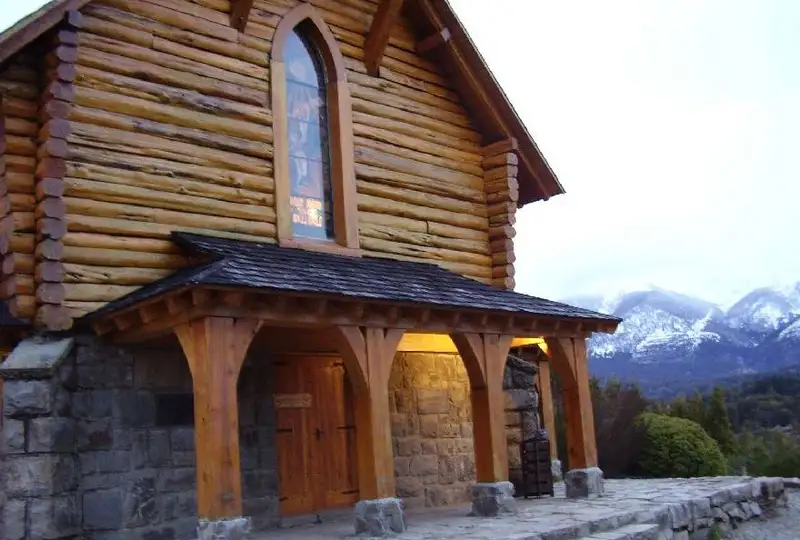
The cathedral was designed by the noted architect Alejandro Bustillo, who offered his plans free of charge for the construction of the church. The architectural proposal follows a Neo-Gothic style with clear French references, seeking to evoke the solemnity of medieval structures through a modern interpretation adapted to the local context. The building has a Latin cross floor plan, a classical arrangement that organizes the interior space in a hierarchical manner.
A distinctive feature of its construction is the orientation of its apse toward the East. This technical decision allows sunlight to fall directly on the altar from the start of the day, interacting with the stained-glass windows to create a dynamic play of light and shadow. From the exterior, this illumination accentuates the architectural planes and facade reliefs, highlighting the verticality and details characteristic of the Neo-Gothic style.
Setting and urban context
The cathedral sits at a strategic intersection of calles Almirante O’Connor and Beschtedt. Its position is not isolated; the church is surrounded by two plazas with well-kept gardens, allowing the structure to be viewed from different angles and depths. This relationship with the surrounding plazas creates a transitional setting between the city’s urban activity and the contemplative character of the religious building.
The integration of the church into this part of Bariloche allows its architecture to engage with the immediate surroundings, functioning as a nucleus around which public space is organized. The combination of the gardens, the plazas, and the imposing presence of the cathedral’s stone and glass forms an urban ensemble where history and architecture converge at a single geographic point.