Capilla de San Eduardo
About 300 meters from Hotel Llao Llao and Puerto Pañuelo, on the edge of the Circuito Chico, the Capilla de San Eduardo stands as one of the most singular religious monuments in Andean Patagonia. Built in 1938 on land belonging to Nahuel Huapi National Park, this small stone-and-timber church is inseparable from the landscape surrounding it: Lago Perito Moreno reflecting in the foreground, the silhouette of Cerro López in the distance, and a forest of cypresses and coihues closing the frame.
A work by Alejandro Bustillo
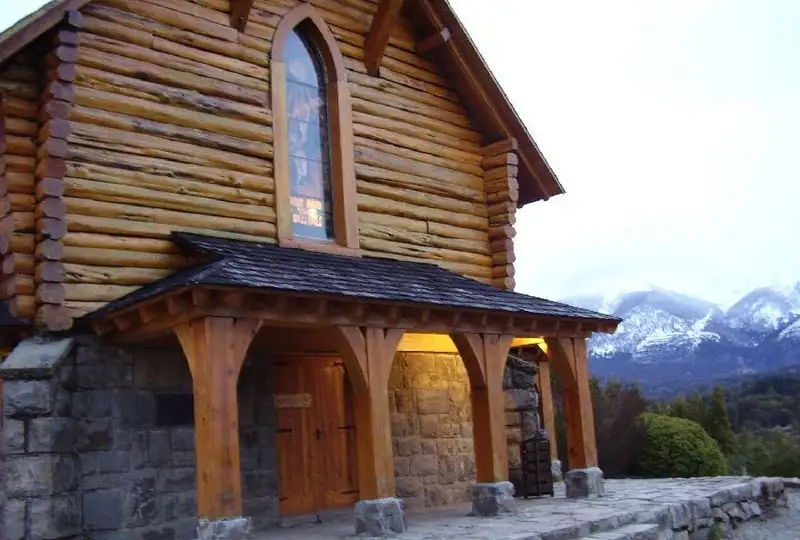
The chapel was designed by architect Alejandro Bustillo, the same figure behind Hotel Llao Llao and much of Bariloche’s architectural identity. His design combines Central European mountain tradition with neo-Gothic elements: a rectangular nave, Patagonian stone walls in grey and ochre tones, and a façade clad in cypress logs left in their natural color. The gabled roof is covered in larch shingles — that organic cladding that deepens with moisture and gives buildings in the area their unmistakable character. Above the main façade, a small needle-shaped bell tower crowns the composition with precise vertical accent.
The chapel was made possible through a donation from Juana G. de Devoto, whose generosity allowed it to be built on public land ceded by the National Parks administration.
Art inside
The austere exterior gives way to a richer visual interior. The stained glass windows, executed by artists Forte and Vázquez Málaga, filter natural light in warm and cool tones that shift across the day. One of the originals was replaced by a replica due to deterioration, though the overall effect of the ensemble remains intact.
The centerpiece of the interior is a retablo donated in 1973 by painter Raúl Soldi, one of Argentina’s most celebrated visual artists of the twentieth century. The frieze — arranged in four panels in a cross formation — narrates episodes from the life of Saint Edward the Confessor: his piety, his justice, and his care for the poor of his kingdom. Soldi’s palette of soft ochres, blues, and whites responds to the natural wood and stone of the walls, integrating the painting into the architectural space without overpowering it.
Saint Edward the Confessor
The chapel’s patron is Edward the Confessor, the last Anglo-Saxon king of England before the Norman Conquest of 1066. Canonized in 1161 by Pope Alexander III, he was venerated for centuries as a model of Christian kingship: he governed with equity, commissioned the construction of Westminster Abbey, and was known for his compassion toward the vulnerable. The choice of a saint so uncommon in the Latin American calendar likely reflects the particular devotion of the parish’s founders, adding a layer of singular history that sets this chapel apart within Patagonia’s religious landscape.
The visit
The chapel deserves more than a passing glance on the Circuito Chico. Stone steps climb from road level to the atrium, giving the building a deliberate presence above its setting. From there, the view across the lake toward Hotel Llao Llao reveals the perspective Bustillo clearly intended: the chapel as the architectural fulcrum of the surrounding ensemble. The human scale of the building, the quiet it holds even in high season, and the visual continuity between its stone walls and the nearby hillside make the experience feel closer to a contemplative viewpoint than to a grand monument.