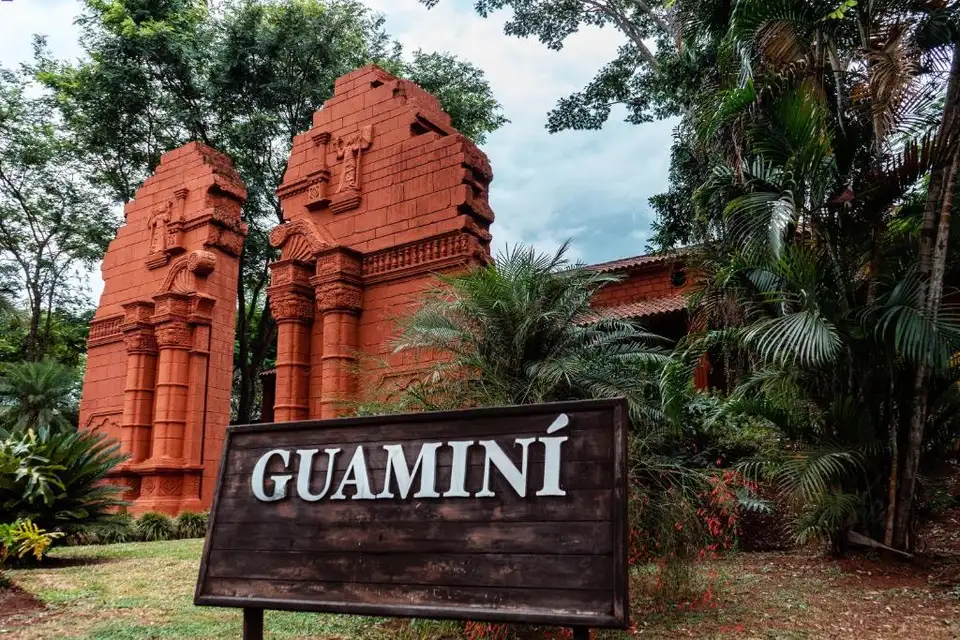
Museo Guaminí
Puerto Iguazú draws the world’s attention to its waterfalls, but it also holds a dense and underexplored human history. Museo Guaminí offers a different kind of pause from the jungle’s rhythm: a journey through the peoples who inhabited this land long before the city took its name, and through the Jesuits who, alongside them, built an unprecedented social experiment in the region.
The museum preserves original and representative objects from Guaraní life, the civilization that for centuries shaped the human landscape of northeastern Argentina. These materials speak alongside the legacy of the Jesuit Missions — that singular chapter of the 17th and 18th centuries in which the Society of Jesus and the Guaraní people built, in the heart of the Misiones jungle, reductions organized around communal labor, music, and baroque art. The thirty missions of the Litoral — of which San Ignacio Miní and Santa Ana are the most visited today — left a material and cultural imprint that Museo Guaminí takes as the guiding thread of its proposal.
At the heart of the visit is a super-panoramic projection, a format that envelops the viewer and allows them to relive key moments of that historical period through image, sound, and narrative working in concert. This is not a conventional audiovisual: the sensory combination is designed not merely to inform but to immerse visitors in the context of the era. For travelers arriving without prior knowledge of regional history, the format is accessible and orienting; for those already familiar with the missions, the visual staging offers a fresh reading of familiar events.
The museum is located in the center of Puerto Iguazú, making it easy to incorporate into an urban day without traveling to the city’s outer edges or the national park. This accessibility makes it a genuine option for travelers who have only a few hours in the city between a visit to the falls and their departure, or for those seeking to balance their natural experience with a cultural anchor.
The museum’s proposal makes particular sense when understood within Misiones’ broader context: the province takes its name from those Jesuit missions, and much of the regional identity — the architecture of the ruins, the everyday use of Guaraní as a living language, the patterns of settlement — cannot be understood without that dual origin. In this sense, Museo Guaminí functions not as a marginal folkloric corner but as a key for reading why Misiones is the way it is.
For families with children, the audiovisual format is more engaging than the static display cases of conventional museums; for individual travelers or couples, the visit delivers thematic depth in little time. Puerto Iguazú’s cultural offer outside the national park is limited, and Museo Guaminí fills a niche that no other urban attraction in the city occupies in the same way: the living history of the people who gave the region its name and the country its backdrop to one of the world’s great natural wonders.