Biocentro Iguazú
The Biocentro Iguazú is an environmental interpretation center located on Ruta Nacional 12, at the entrance to Puerto Iguazú, where the Paranaense Forest — the Argentine expression of the Atlantic Forest — is presented in an organized, accessible way to visitors arriving in the region. More than a conventional zoo or botanical garden, the Biocentro functions as a living mirror of the ecosystem surrounding the Falls: a place to encounter the area’s fauna and flora before entering the national park, or as a natural complement after visiting it.
The circuit moves through different sectors connected by paths amid lush vegetation. The aquarium displays river species native to Misiones’ waterways, while the orchid garden and the bromeliads and aquatic plants section illustrate the botanical richness of what is Argentina’s most threatened biome. The Laguna Los Pájaros, integrated into the grounds, draws native birds and has become a particularly valued spot for nature photography enthusiasts.
The serpentarium is one of the Biocentro’s most historically significant sectors. Many of the species housed there arrived following the closure of the Zootoxicological Center that scientist Alejandro Vogt had directed in the city of Oberá. Vogt dedicated his career to developing anti-venom serum in Argentina, and when his center was forced to close, its specimens were redistributed among institutions to avoid being destroyed. The Biocentro received a substantial number of those species, making this section a repository of genuine herpetological knowledge — not merely an exhibit.
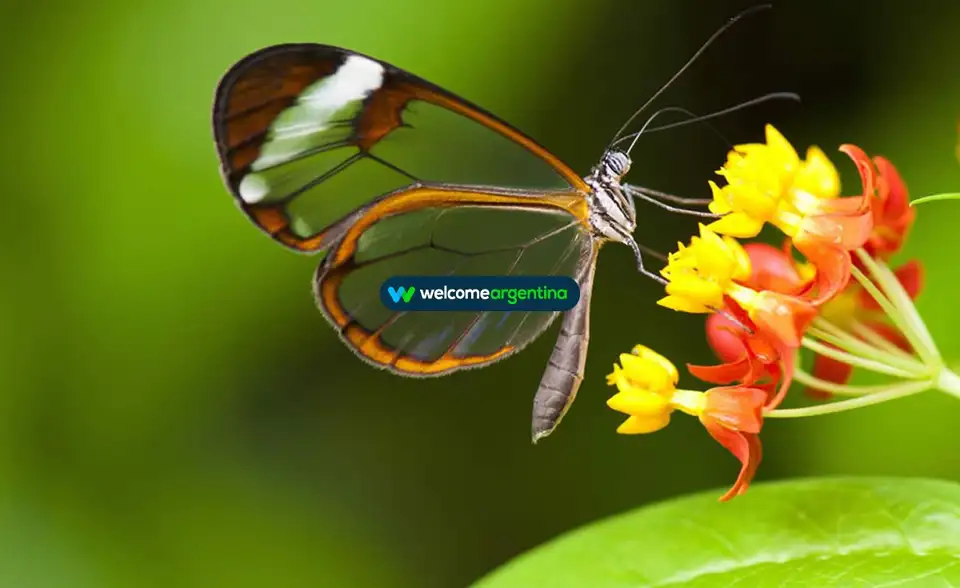
The butterfly garden is, for many visitors, the most striking experience on the grounds. It includes a breeding laboratory that keeps the reproductive cycle of humid tropical forest species active — a particularly meaningful effort in Misiones, a province home to roughly three quarters of all butterfly species recorded in Argentina. The space allows visitors to observe these species in a simulated natural environment and to understand the ecological role they play within the forest system.
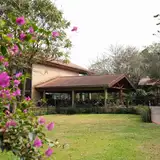
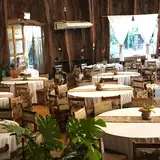
The architecture throughout the site favors materials that speak to the surroundings: stone, wood, and glass form the structures of the Biocentro, which at no point seeks to impose itself over the surrounding vegetation. This same approach informs El Pueblito, the themed hotel integrated into the grounds, set beside Laguna Los Pájaros. With colonial references in its design, interiors created by local artisans and visual artists, and a commitment to renewable energy and sustainability-aligned suppliers, El Pueblito reinforces the coherence of the whole: a space where tourism, conservation, and hospitality advance under a shared philosophy.
Within Puerto Iguazú’s activity circuit, the Biocentro occupies a different space from the grand attractions of the national park. It doesn’t compete with the Falls, nor does it try to: it is, rather, a point of contact with the ecological logic that makes those falls possible. For travelers whose interest in nature extends beyond the visual spectacle, it stands as a stop with its own substance.