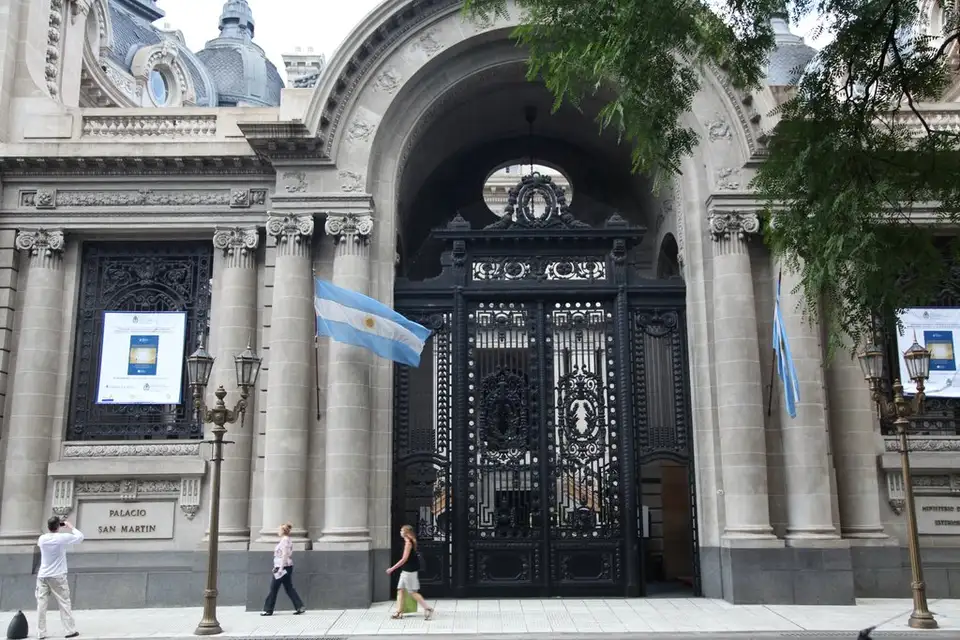
Palacio San Martín
Located in the heart of the Retiro area, the Palacio San Martín stands as one of the most significant examples of stately early-20th-century architecture in Buenos Aires. This building, which today serves as the seat of the Ministerio de Relaciones Exteriores y Culto, is not only a center of diplomatic activity but a fundamental piece of the national historic heritage. Its presence in the city’s urban fabric marks a point of reference where the private history of Argentina’s great families is intertwined with the institutions of the state.
Architecture and original design
Construction, completed around 1909, was the work of Scandinavian architect Alejandro Christophersen. The original project was commissioned by Mercedes Castellanos de Anchorena with a specific family purpose: to create a residence that would allow her three sons — Aarón, Emilio, and Enrique — to live under a single urban frontage while maintaining their independence. To achieve this, the architect designed a building that, although outwardly perceived as a monumental unit, is composed of three independent wings.
The predominant style is Beaux Arts, with a strong influence from French architecture of the period, similar in concept to the Parisian Grand and Petit Palais. The façade was even recognized in 1910 as one of the finest in the city. The design is organized around a central oval-plan honor courtyard that acts as a connecting nucleus, and features a rotesca or rotunda on the first floor functioning as a covered walkway that integrates the building’s various sections.
Institutional transformation
What began as a luxury private residence for the Anchorena family underwent a fundamental change of purpose in 1936. That year, the state acquired the property to house the functions of the Argentine Foreign Ministry. From then on, the building was renamed Palacio San Martín and became the epicenter of the country’s foreign relations.
This transition allowed a space conceived for the domestic life of Buenos Aires’s upper society to be adapted to accommodate the reception rooms and offices required for international diplomacy. Despite this change of use, the structure retains its stately character, preserving the scale and sumptuousness that defined the great mansions of Argentina’s Belle Époque.
Urban context and legacy
The palace is set in an environment where monumental architecture engages in dialogue with the historical development of Buenos Aires. Its location, among the streets Arenales, Esmeralda, and Basavilbaso, places it in an area of considerable urban significance, near other landmarks of the city’s architectural heritage. The preservation of its façade and complex internal layout makes it possible to understand how Christophersen’s architecture resolved intricate spatial challenges by creating a unified front that conceals a multi-family structure.