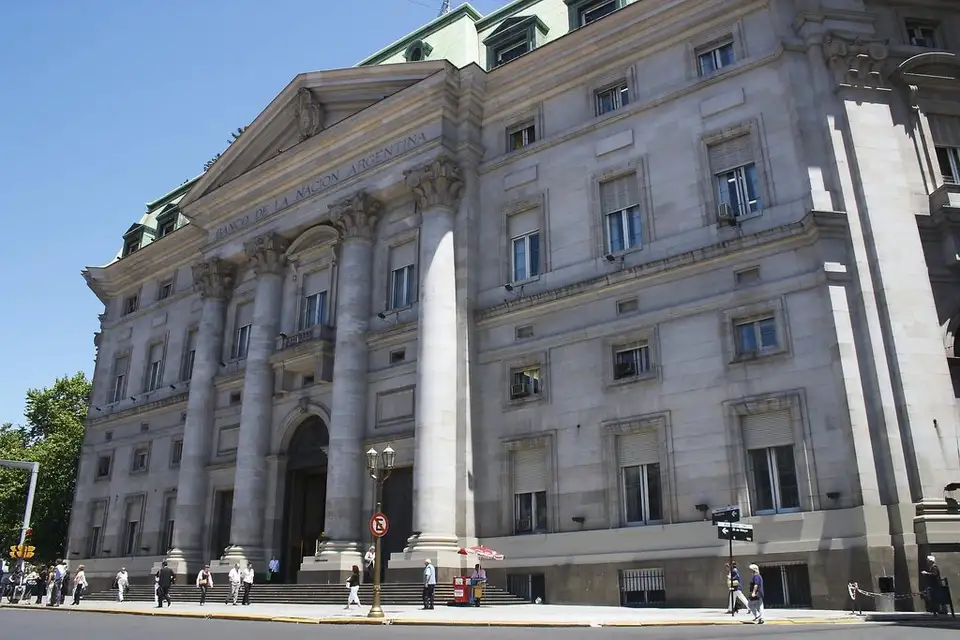
Banco de la Nación Argentina
Located in the historic core of Monserrat, the building of the Banco de la Nación Argentina stands as one of Buenos Aires’s most imposing architectural landmarks. Situated near Plaza de Mayo, this complex is not merely a financial headquarters but a testament to the urban expansion and institutional consolidation of the city during the mid-twentieth century. Its presence within the foundational grid of the Argentine capital connects it directly to the narratives of the colonial era and the modernization processes that transformed Buenos Aires into a global metropolis.
Architecture and monumentality
Construction of the building began in 1938 under the direction of architect Alejandro Bustillo, a key figure in Argentine architecture. The building process extended into the mid-1950s, resulting in a structure that combines solidity and elegance. One of its most distinctive and internationally recognized features is its impressive dome. With a diameter of approximately 50 meters, this cupola stands out for its scale and mass, placing it alongside structures such as the Basilica of Saint Peter and the United States Capitol among the largest domed constructions in the world.
Upon entering the building, the scale of the space becomes immediately apparent. The design aims to convey a sense of permanence and order, employing materials and volumes that speak to the institutional character of the place. The size of the entrance hall and the engineering required to support such a structure offer a visual journey in which light and proportion play a fundamental role in the visitor’s perception.
Historical and territorial context
The site now occupied by the main branch carries deep historical significance, tied to the very origins of the city. Before the bank’s consolidation here, this area witnessed foundational milestones: it was home to the first church that would give rise to the present-day Catedral Metropolitana, and to the old ‘Hueco de las Ánimas’, a space that served as Buenos Aires’s first vacant lot and would later become part of the foundations of the original Teatro Colón.
This layering of historical strata means the building is not an isolated element but a piece that completes the fabric of Monserrat. Walking through its surroundings, one perceives how the bank’s architecture enters into dialogue with other landmark buildings such as the Casa Rosada and the Cabildo, forming part of an ensemble that defines Argentina’s political and cultural identity. The presence of this concrete and stone giant at the heart of the city’s oldest district allows one to trace Buenos Aires’s evolution from its colonial roots to its consolidation as a financial and administrative center.