Palacio Bencich
Located in the heart of the San Nicolás neighborhood, in the dense core of Buenos Aires’ microcentro, Palacio Bencich stands as a testament to the architectural ambition that defined the city during its period of expansion. Situated in an area where the urban fabric becomes particularly dense and complex, the building distinguishes itself not only through its scale but also through its strategic position at the intersection of streets converging on the Plazoleta Saenz Peña. Its presence serves as a visual landmark in an environment dominated by the verticality of the financial district.
Architecture and urban composition
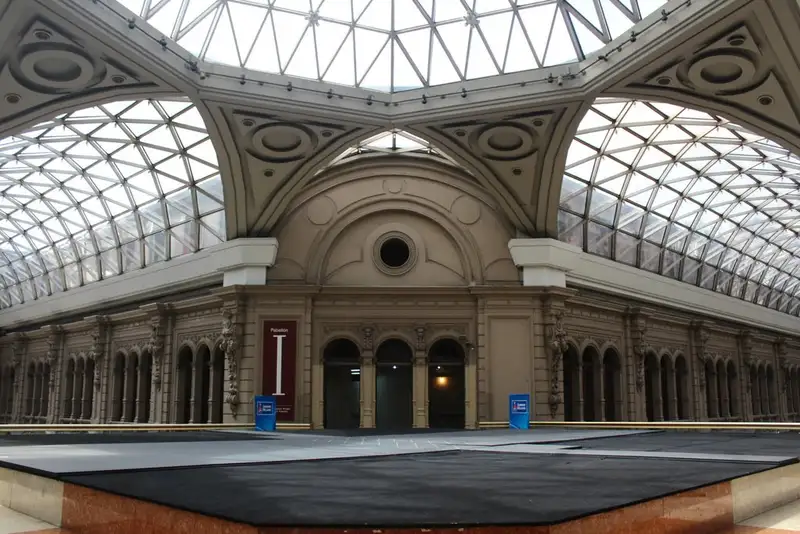
The work, attributed to architect Le Monnier, displays a notable expressive force that balances elements of classicism with more modern and harmonious forms for its era. The design is characterized by a structural boldness that manifests most clearly in its two tall domes, which function as visual crowns identifiable from various points in the surrounding area.
A distinctive feature of the building is how it interacts with public space. It takes advantage of a broad diagonal perspective, a phenomenon rarely found in the rigid grid of the Buenos Aires microcentro. This arrangement results from the convergence of several streets at the Plazoleta Saenz Peña, allowing the façade and volumes of the palace to unfold with a spatial freedom that breaks the monotony of the surrounding urban fabric.
Context and surroundings
Palacio Bencich sits within a highly dynamic context, surrounded by the commercial and administrative activity of San Nicolás. Positioned at this nerve center, the building functions not only as a piece of architectural heritage but also as an element that gives identity to the area around the intersection of Maipú and neighboring streets. Its architecture engages with the history of a Buenos Aires that sought to project an image of modernity and solidity.
The structure integrates into the city’s urban landscape with a monumental scale that contrasts with more contemporary office buildings. Observing its classical details offers insight into the aesthetic transition the city center underwent, while maintaining visual coherence with other landmarks of the area’s architectural heritage.