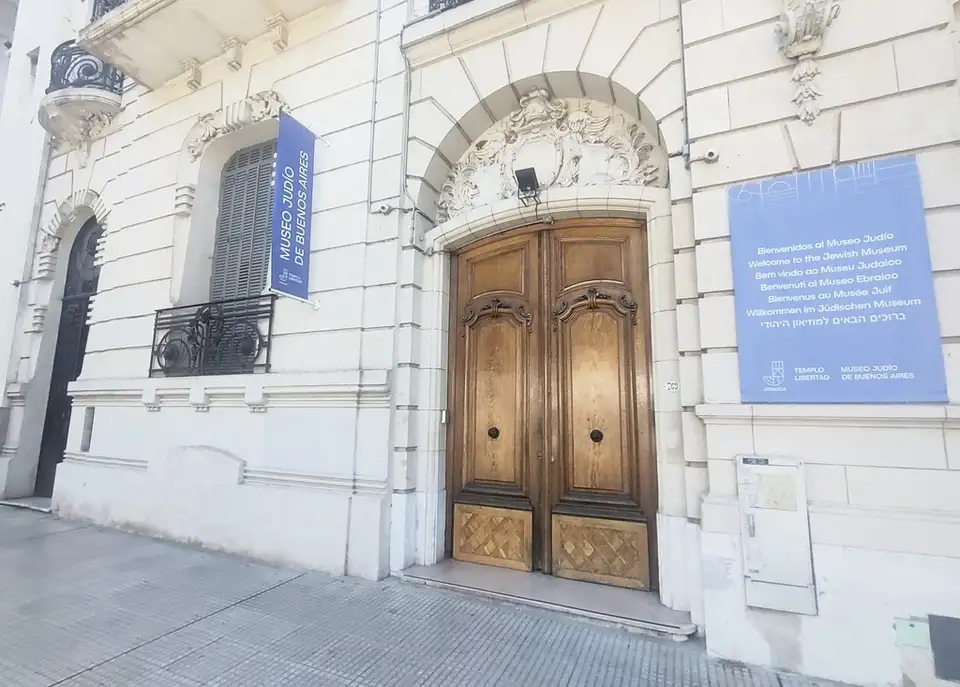
Museo Judío de Buenos Aires
Located in the heart of the San Nicolás neighbourhood, the Museo Judío de Buenos Aires functions as a meeting point between historical memory and contemporary artistic expression. Situated on Calle Libertad, the space integrates into the urban fabric of Buenos Aires, sharing grounds with the Templo Libertad — a structure distinguished as Argentina’s first synagogue and declared a National Historic Monument. This placement is no coincidence; the museum stands on what was once the core of the city’s Jewish quarter, making a visit a journey through the roots of a community that left a deep mark on Buenos Aires’s identity.
Heritage and testimonial memory
The institution, founded in 1967 by Dr. Salvador Kibrick, holds a legacy that began with the donation of personal objects and pieces of significant symbolic value. The museum’s collection includes elements fundamental to understanding both religious and everyday life: Torah scrolls, Sidurim, mezuzot, and a collection of antique books. These objects are not mere display pieces but testimonies to cultural continuity across generations. The presence of coins and other ritual artefacts allows for a reconstruction of the community’s trajectory from its origins through to its consolidation on Argentine soil.
The museum is organised into distinct areas that allow a multidimensional approach to its subject matter. It includes a testimonial zone where historical objects take centre stage, complemented by a library and an art gallery that animate the site’s cultural offering. This structure means the space functions not merely as a repository of antiquities but as an active centre for cultural dissemination.
Art and the present
Beyond its historical character, the museum operates as a platform for the visual arts. Through its galleries, exhibitions are presented that connect tradition with a contemporary perspective. One example is the show dedicated to the artist Yente, whose works form part of the permanent collection and explore Jewish identity and tradition through a distinctive aesthetic lens.
The museum’s rooms also offer spaces for reflection on contemporary events that have shaped collective memory. The institution uses its galleries to address themes of resilience and the consequences of global conflicts, incorporating audiovisual media and photography as narrative tools. This capacity to connect the past with present-day processes makes the museum a space of ongoing dialogue about identity and cultural continuity within the social fabric of Buenos Aires.