Patio Andaluz
The Patio Andaluz is a space of ornamental value that forms part of the landscaped ensemble of Parque Tres de Febrero, located specifically at one of the entrances to the Rosedal de Palermo. Beyond its function as a passageway or resting point, this area stands as a material testament to international cooperation and cultural exchange between Buenos Aires and Spain. Its presence at the heart of one of the city’s most important parks adds an architectural texture that is distinct from the predominantly vegetated surroundings.
Origin and material composition
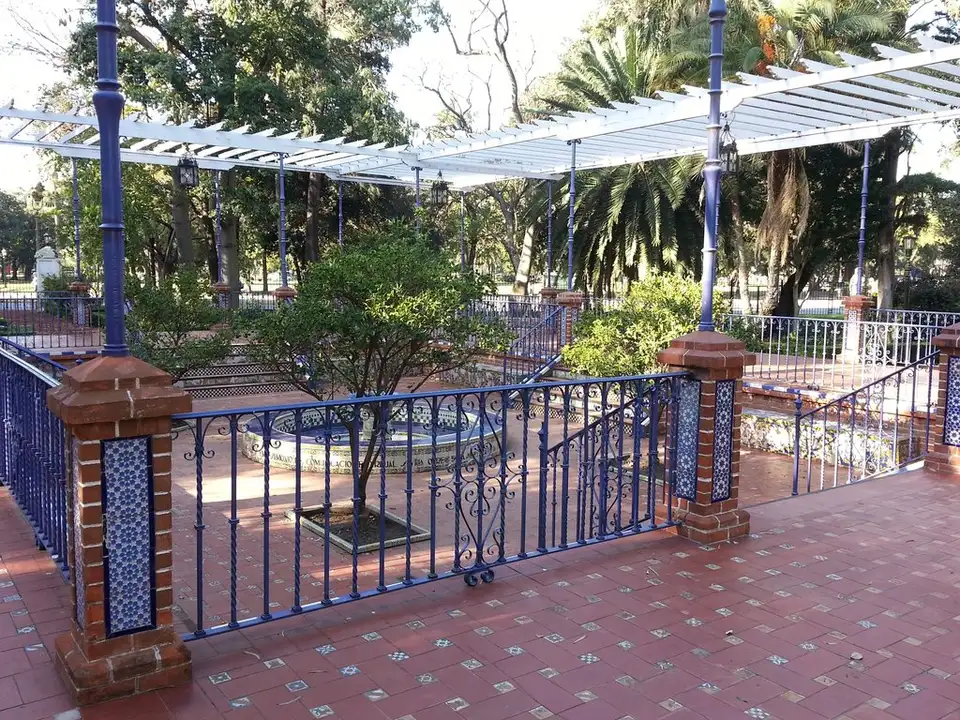
This space owes its existence to a donation made by the Ayuntamiento de Sevilla, which made it possible to transport constructive elements from Andalusia to the banks of the Río de la Plata. The construction was not a purely local process; a large part of the essential components arrived in Buenos Aires by ship to be assembled in the park. Among the most notable materials are the columns and metal railings, pieces produced by the factory Hijos de Manuel Montes, also based in Seville.
The floors and surfaces of the patio reflect a remarkable diversity of geographic origins. The red stoneware tiles covering the area were supplied by French firms such as P. Virabanc and the Compañía La Fourmi, of Marseille. Likewise, the perimeter borders include pieces that arrived from Italy, establishing the Patio Andaluz as a point of convergence for European craftsmen and materials. Even the majolica-clad benches situated on the exterior of the patio were a contribution from the limited company Establecimientos Americanos Gratry.
The legacy of Sevillian craftsmanship
A detail that defines the visual identity of the place is the quality of its ceramics. Records indicate that the materials were transported by the factory José Laffite, a traditional craftsmen’s firm from the Triana neighbourhood in Seville. The technique used in these ceramics and tiles preserves the heritage of the Muslim and Christian ancestors of that craftsmen’s family, lending the patio a historical character that transcends its location in Buenos Aires.
Walking through this area, one perceives how the Andalusian-influenced architecture enters into dialogue with the landscape design that Carlos Thays implemented on the land expropriated following the fall of the government of Juan Manuel de Rosas. The Patio Andaluz does not function as an isolated element, but as a piece of ornamentation that complements the structure of Parque Tres de Febrero, integrating the history of immigration and commerce with the urban planning of Buenos Aires.