Museo Polifacético Rocsen
On the outskirts of the town of Nono, watched over by the imposing Sierras Grandes, stands one of the most singular sites in the province of Córdoba: the Museo Polifacético Rocsen. This space is not merely a repository of old objects, but the result of the vision and effort of a single man, Juan Santiago Bouchon, a Breton immigrant who arrived in Argentina in 1950 with the firm intention of creating a cultural legacy for humanity. Officially inaugurated on January 6, 1969, the museum has grown organically to house more than 60,000 pieces from every corner of the world and every era.
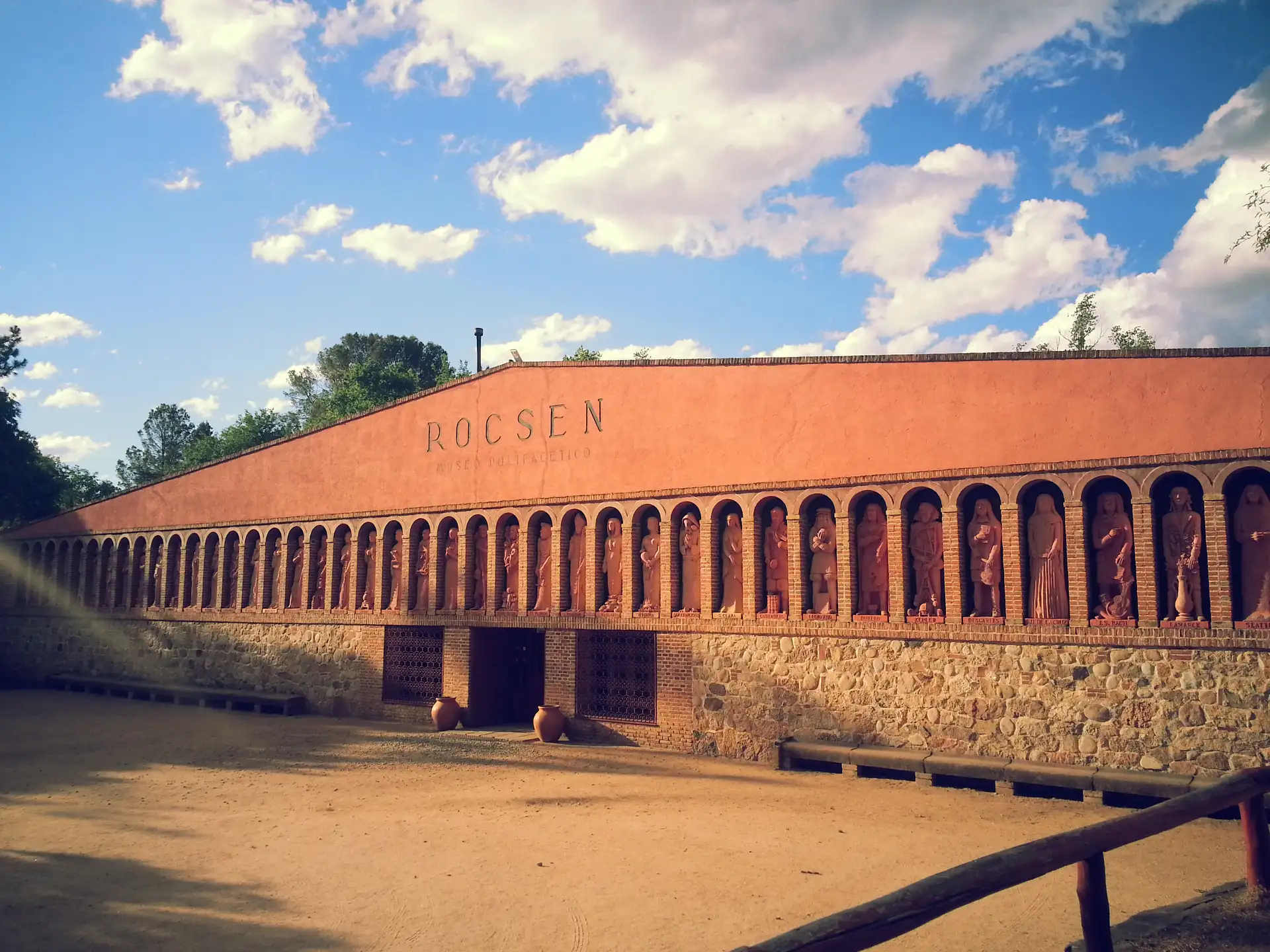
The experience at the Rocsen begins before crossing the threshold. Its façade is a work of art in itself, designed by Bouchon with a deep symbolic intent. It features 49 niches (the result of multiplying seven by seven) containing statues of historical figures who have contributed to knowledge, peace, and humanism. From Leonardo da Vinci and Johannes Kepler to Martin Luther King and Mother Teresa of Calcutta, each figure represents a link in the chain of human knowledge. At the center, presiding over the entrance, is an image of Jesus surrounded by children, reinforcing the message of universal brotherhood that the founder wished to convey.
Once inside, the visitor encounters a journey that defies conventional classification. The rooms, though organized alphabetically, propose a constant dialogue between disciplines. One can move from a room of American archaeology — where a Nazca mummy and skulls bearing millennia-old trepanations stand out — to a section dedicated to the evolution of technology, with cameras from every era, printing presses, and antique engines. The collection is truly multifaceted: it includes Catholic iconography and nineteenth-century carriages alongside a picture gallery, a collection of musical instruments, and display cases devoted to biology and geology.
The philosophy behind the Rocsen is as important as its contents. Juan Santiago Bouchon, who died in 2019, held that “teaching is the best way to learn” and that culture has no meaning unless it is public and accessible. His move from Europe consisted of 23 containers loaded with treasures that today form the core of this non-profit institution, now managed by his children. The name “Rocsen” comes from a Celtic fusion of Latin roots meaning “Holy Rock,” a name that reflects the solidity and near-sacred character that the founder attributed to the preservation of heritage.
Exploring the museum with the depth it deserves takes time — something the institution acknowledges by offering a “return voucher” at no extra cost if a visitor does not finish the tour in a single day. There is no Wi-Fi or modern climate control, a deliberate choice that encourages disconnection from today’s frantic pace in order to immerse oneself fully in history. Pets are allowed as long as they are kept on a leash, and the general atmosphere calls for silence and attentive observation. Visiting the Rocsen is, ultimately, an exercise in curiosity and an invitation to reflect on our own identity through the objects that have defined us as a species across the centuries.