Villa Normandy
Located at the intersection of avenida Colón and Viamonte, Villa Normandy stands as one of the most enduring examples of the residential expansion that transformed Mar del Plata in the early twentieth century. Situated in the La Loma neighborhood of Stella Maris, this building is not merely a historical structure but a fragment of the architectural identity that sought to replicate the aesthetic of the semi-urban areas of northern France on the Argentine coast.
Architecture and origins
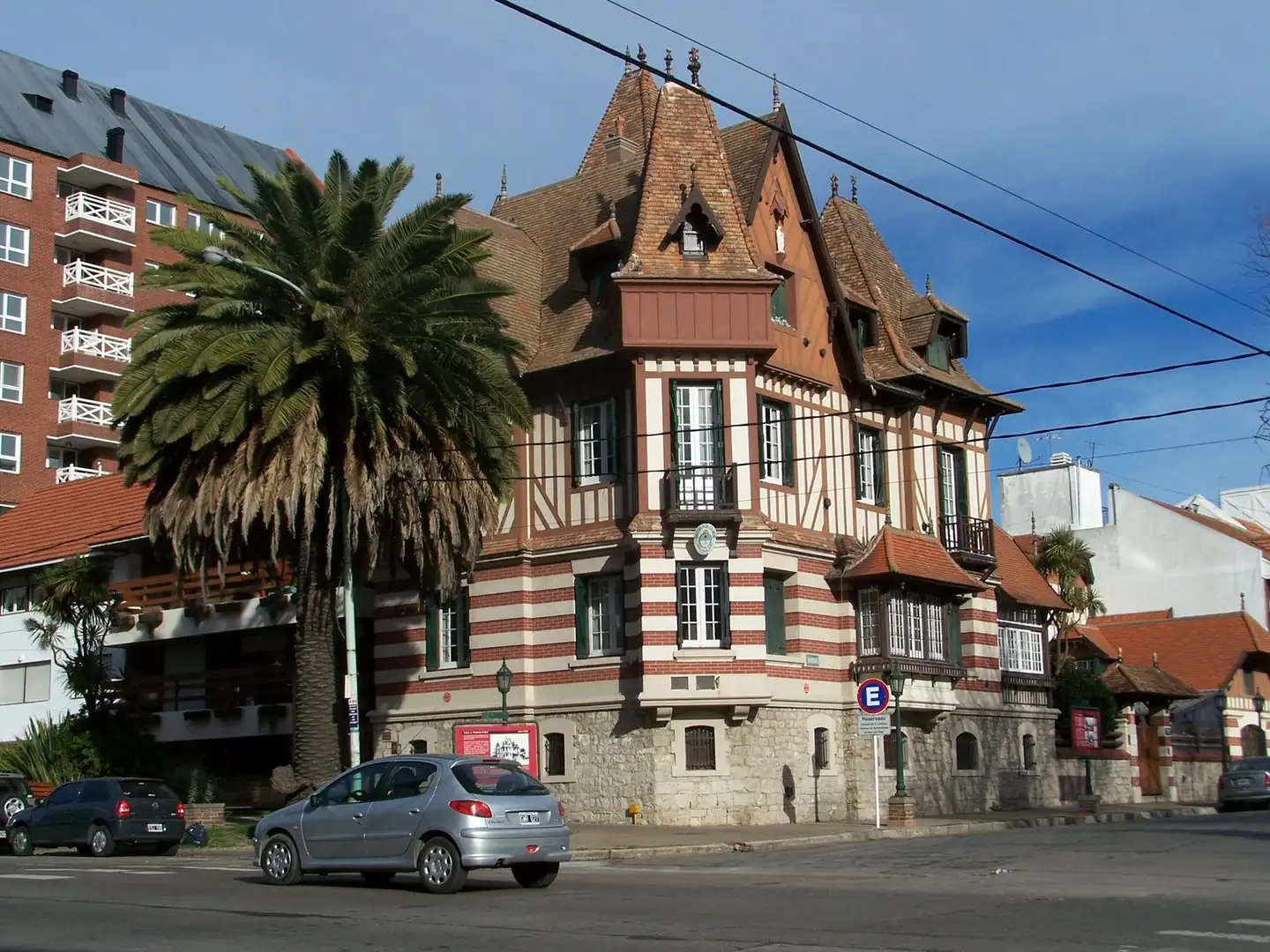
The villa was designed between 1918 and 1919 by architect Gaston Mallet. Its design belongs to the Picturesque movement with a distinctly Norman variation — a style that sought to integrate the building with its surroundings through organic forms and materials evoking European tradition. The property was originally conceived as a summer residence for the family of Mr. Felix Delor, who, like the architect, had ties to the French region.
The building is distinguished by a complex interplay of volumes and textures. The façade features layered levels marked by the application of stone, mortar, and faux gold-leaf details. One of the most distinctive features is the pronounced pitch of its four-sided roofs, covered with flat tiles that produce an irregular, dynamic silhouette. This composition is complemented by colored ceramic pinnacles that lend a subtle polychromy characteristic of the style.
Structural details and surroundings
Walking through the area, the structural elements allow one to identify a transition toward other aesthetic movements of the period, such as Art Nouveau. The entrance to the villa is defined by large wooden gates supported by stone pillars, establishing a clear yet permeable boundary with the public space. The balconies and terraces feature wooden railings that reinforce the rustic and stately aesthetic of the ensemble.
The significance of this building lies in its capacity to represent the period of prosperity among Buenos Aires families who sought to establish permanent or seasonal residences in the city. Through its materials — stone and wood — Villa Normandy connects with the tradition of Anglo-Norman chalets that defined the landscape of neighborhoods such as Los Troncos and Stella Maris.
Over the decades, the function of the building has evolved, reflecting the social and administrative changes of Mar del Plata. Having passed through various owners and restoration processes, the property took on new institutional uses, at one point housing the Italian Consulate and currently serving as the seat of the Ministerio Público Fiscal Federal, maintaining its relevance within the city’s architectural heritage.