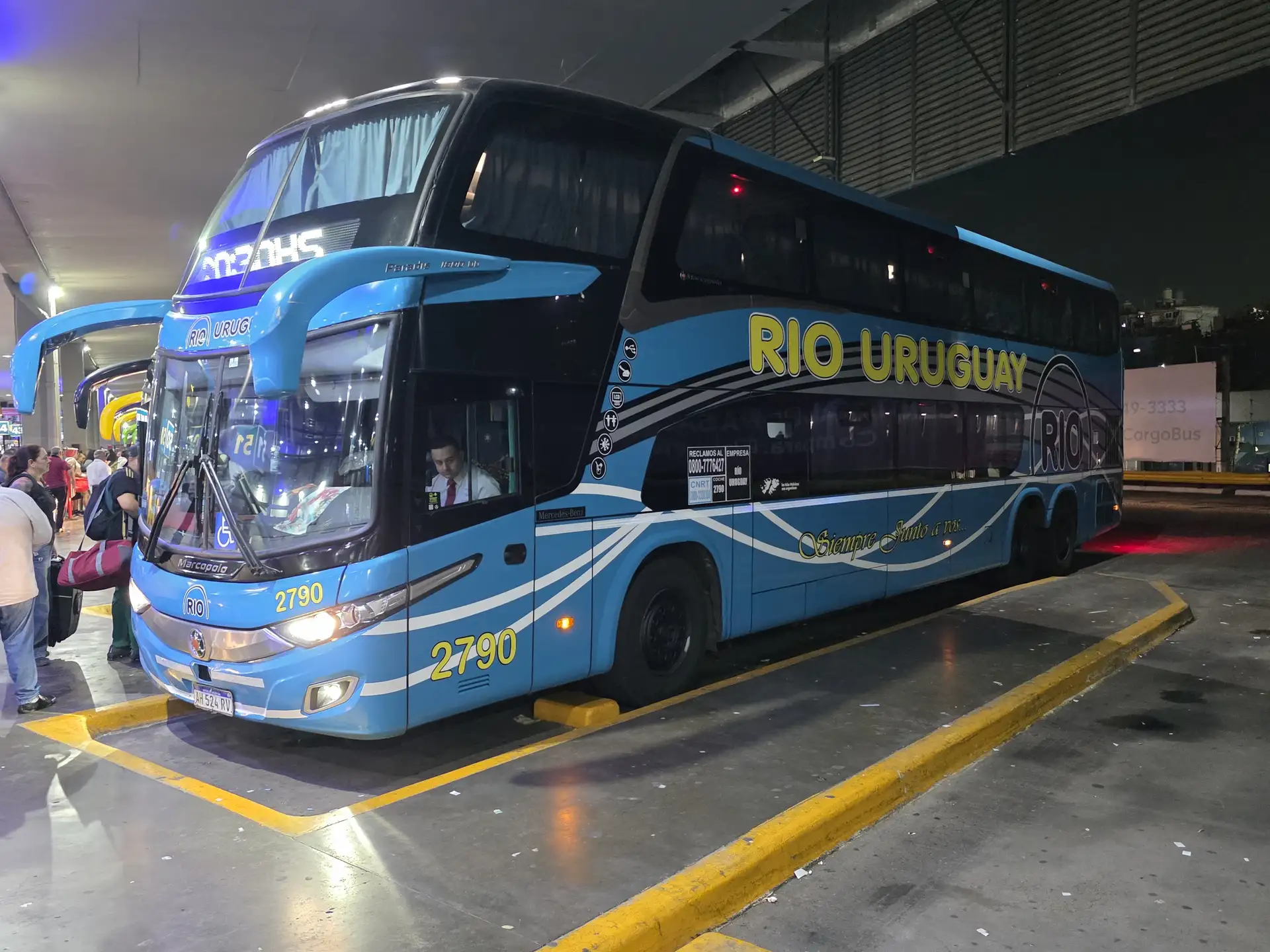
Río Uruguay Bus
Río Uruguay Bus is a historic passenger and parcel transport company based in Posadas. In the everyday map of Misiones, it plays a more practical than scenic role: it is one of the brands that make it possible to leave the provincial capital for the Litoral, central Argentina, and, in some cases, cities in southern Brazil. For travelers in the region, its value lies less in spectacle than in continuity: decades of operation, a broad network, and an identity closely tied to the road development of Misiones.
The company was founded in July 1969 in Apóstoles by Mariano Skrabiuk and Lila María Kruk. Its first service ran along the Río Uruguay between Colonia Liebig and Santo Tomé, Corrientes, on provincial route 40, and the company took its name from that line. Before becoming a nationwide operator, it grew through very concrete solutions: special trips, school transport, and staff transport services connected to the productive life of Misiones. The history told by the company itself preserves that regional, handcrafted origin, far from expansion planned from a large capital.
Over time it added milestones that brought it closer to its current form. The company remembers an early trip carrying high school graduates to Iguazú Falls, when access still involved dirt and rocky roads; it also recalls work for the Las Marías estate, where it operated up to 10 urban buses until 2000. After the 2001 crisis, it incorporated Expreso Ciudad de Posadas and Empresas Asociadas, a move that consolidated its base in the provincial capital and expanded its presence on provincial, intermunicipal, and national routes.
Today Río Uruguay offers services across Argentina and highlights a set of popular destinations that includes Buenos Aires, Córdoba, Rosario, Iguazú, and Corrientes, as well as Florianópolis, Porto Alegre, and Camboriú. That mix makes its profile clear: it is not just a line for linking nearby towns, but a network useful for people traveling for work, study, tourism, or family errands. In Posadas, its central office serves as a reference point for sales and inquiries, and the brand also operates Río Uruguay Encomiendas, its parcel service authorized as a postal operator. That dual role, as both transport and parcel service, gives it a broader presence than a conventional terminal: it appears both in long-distance travel and in the logistics of shipments between branches.
For that reason, Río Uruguay Bus fits well into a broad reading of Posadas as a city of transit and connection. Its presence helps explain how people and shipments move between Misiones, Corrientes, Buenos Aires, and part of southern Brazil. In a city where regional mobility is part of everyday life, the company belongs to the real travel landscape: less visible than a monument, but much more present in the concrete experience of moving to and from the provincial capital.