San Ignacio Miní
San Ignacio Miní represents the highest point of the social, religious, and architectural experiment that united the Society of Jesus with the Guaraní nation for nearly two centuries. Located in the present-day town of San Ignacio, about 60 kilometers from Posadas, these ruins are not merely an archaeological site but a monument to a transcultural civilization that flourished in the heart of the Misiones jungle. Declared a UNESCO World Heritage Site in 1984, they constitute the best-preserved reduction among the thirty that made up the Jesuit Province of Paraguay.
The history of San Ignacio Miní is one of resilience and movement. It was originally founded in 1610 by Fathers José Cataldino and Simón Maceta in the Guayrá region, in present-day Brazilian territory. However, the constant harassment of the bandeirantes — Portuguese slave hunters — forced the community to undertake a mass exodus in 1632. Led by Father Antonio Ruiz de Montoya, thousands of Guaraní navigated the Paraná River in search of refuge to the south. After several temporary resettlements, the mission found its definitive location in 1696, where the imposing stone structures we admire today began to take their final form.
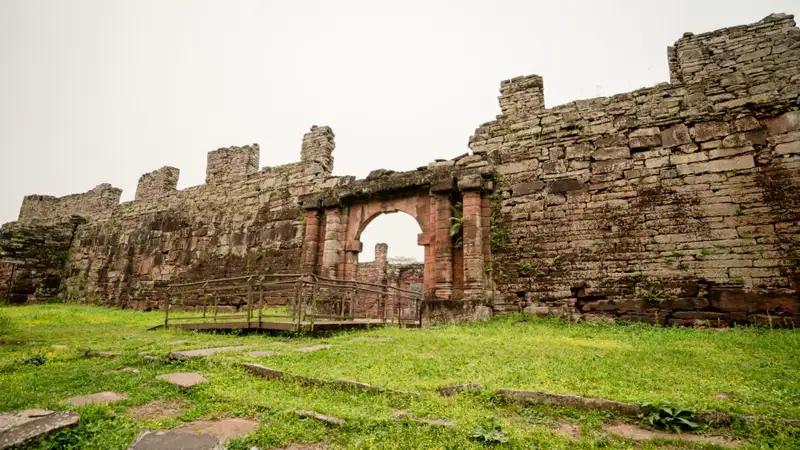
At its peak, during the first half of the eighteenth century, San Ignacio Miní housed more than 4,500 people, becoming a center of feverish activity and advanced communal organization. The urban layout followed a strict functional and symbolic logic: a vast central plaza of 125 by 150 meters served as the epicenter for religious and civic festivities. The main buildings were distributed around this space. The Temple, a colossal structure 74 meters long and 24 meters wide, dominated the perspective with its red sandstone walls. Beside it stood the priests’ residence, the cemetery, the cabildo, and the workshops where the Guaraní developed trades in ironwork, silversmithing, carpentry, and sculpture.
What fundamentally distinguishes San Ignacio Miní is the birth of what is known as “Guaraní Baroque.” This aesthetic movement emerged when European baroque-inspired techniques and blueprints fused with the craftsmanship and symbolic interpretation of local artisans. Using blocks of red sandstone quarried in the area, the Guaraní carved friezes and doorways of astonishing sophistication. In the remains of the temple and the facades, it is still possible to make out angels with indigenous features, doves, and a profusion of jungle vegetation that replaced traditional European motifs with the native flora of the littoral region, creating a visual language unique in the world.
After the expulsion of the Jesuit order in 1767 by decree of King Carlos III, the mission entered a long period of abandonment and deterioration. In 1817, during border conflicts, it was looted and burned by Luso-Brazilian and Paraguayan troops, remaining buried under vegetation for nearly a century. It was not until the late nineteenth century that the poet Leopoldo Lugones drew attention to its incalculable historical value, which initiated systematic restoration work in the 1940s. These efforts made it possible to recover walls up to two meters thick and the facades that stand today as witnesses to that past.
Visiting the site today involves a sensory journey that begins at the interpretation center, where life in the reductions is contextualized before entering the historical enclosure. The route allows visitors to walk through the ancient dwellings or rows of living quarters and take in the scale of the former college and workshops. The local Museo Jesuítico safeguards archaeological pieces and sculptures recovered from excavations that help convey the scope of daily life at the mission. As night falls, the experience is completed by a Sound and Light show that, through projections onto the historical walls, narrates the epic of the missions, momentarily restoring the voice of those who inhabited this enclave of stone and jungle.