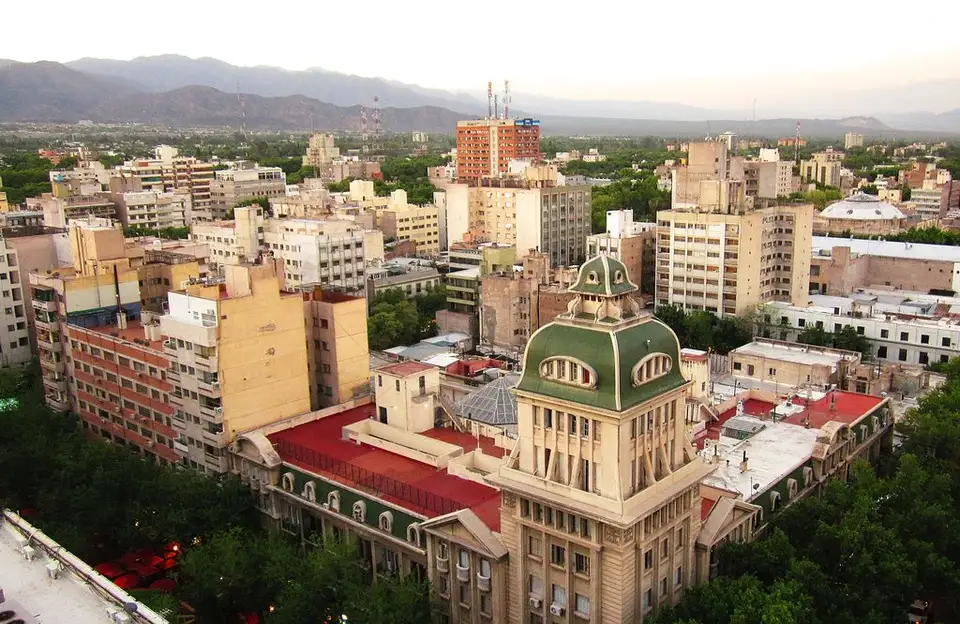
Edificio Gómez
Located at the intersection of Avenida San Martín and Garibaldi, in the Cuarta Sección of the city of Mendoza, the Edificio Gómez stands as an unavoidable reference point for understanding the urban evolution of the region. It is not merely a large-scale structure; its significance lies in having been declared a National Historic Monument in August 2017, cementing its status as a material testament to Mendoza’s architectural development in the mid-twentieth century.
Architecture and Construction Technique
The building, dating from 1953, represents a significant transition toward modernity. Designed by architect Manuel Civit, the structure employs a system of reinforced concrete, steel, and glass that defines its visual language. The building belongs to the currents of the international style and displays features characteristic of brutalism, where the honesty of materials and the force of the structure take center stage. Reaching 60 meters at its main structure — and up to 80 meters when the pinnacle is included — its 13 floors dominate the skyline of the area.
The building’s composition is distinguished by its verticality and the integration of glazed surfaces that allow for constant interaction between the interior and the urban environment. The use of reinforced concrete responds not only to a technical need for stability but also contributes the texture and visual weight characteristic of works intended to endure. The presence of the pinnacle adds a distinctive element that completes its silhouette on the Mendoza horizon.
Presence in the Urban Landscape
From a spatial perspective, the Edificio Gómez functions as an observatory of the city. Its strategic location makes it possible to capture different views of the surrounding urban sectors, offering a panoramic perspective that connects the dense fabric of the Cuarta Sección with the rest of Mendoza’s urban tissue. The scale of its structure, rising significantly above the traditional buildings of the area, creates a contrast that sets the rhythm of Avenida San Martín.
Its relevance extends beyond the purely aesthetic to occupy the realm of cultural heritage. By being recognized as a national monument, the building ceases to be a merely functional construction and becomes an object of study and preservation. The survival of its original features allows those who pass through the area to recognize the mark of modern architecture in a context that has undergone multiple urban transformations.