Museo Histórico Nacional
Situated at the highest point of Parque Lezama, the Museo Histórico Nacional serves as a fundamental axis for understanding the construction of Argentine identity. Located in the San Telmo neighborhood, this space not only safeguards objects and documents but integrates into the urban surroundings as a living testament to the country’s social and political transformations. Its significance lies in its ability to connect pre-Columbian periods, the colonial era, and the events that shaped the 20th century within a single narrative.
Architecture and territorial heritage
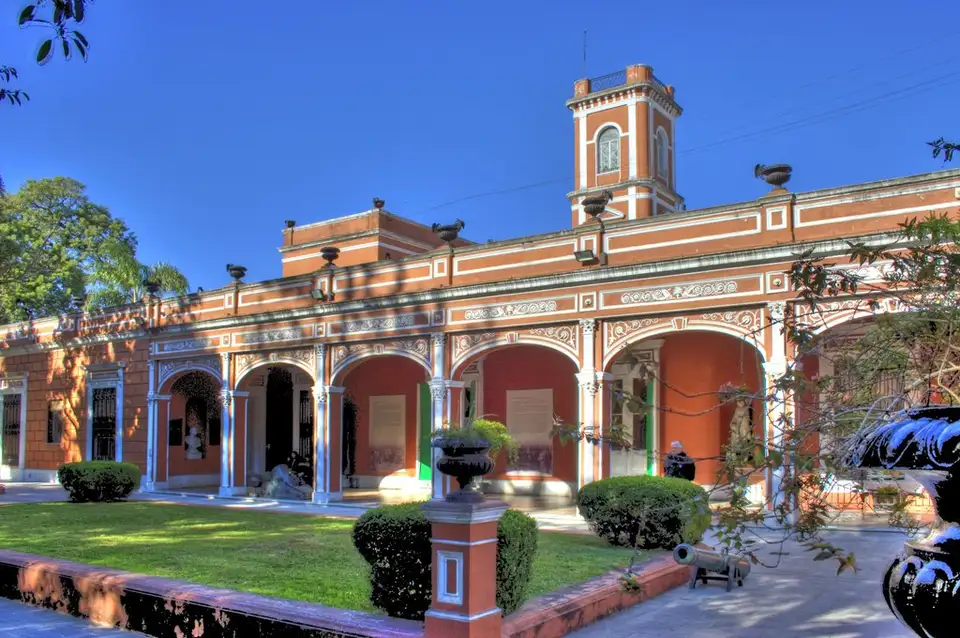
The building itself is an essential component of the experience. What is today known as the museum was originally part of the lands of José Gregorio de Lezama, who in the mid-19th century designed a residence to the luxury standards of the time alongside a private park. After his death, the property passed into public ownership under the condition that it maintain its character as open space for the city. The current structure is the result of a remodeling of that original mansion to fulfill its cultural function from the early 20th century onward.
Walking through the surroundings, one notices the transition between stately architecture and the natural setting of the park. The entrance gardens preserve elements that reference the military and civil history of the region, with iron and bronze figures including battle cannons and antique bells. A distinctive architectural detail is the Puerta de los Leones, an element that marks the boundary and connection between the outer gardens and the museum’s core.
A journey through Argentine memory
The museum’s internal layout is organized to offer a comprehensive view of national history. The collections allow visitors to observe the evolution of daily life and political milestones through pieces of clothing, historical furniture, and original documents. Among the most significant objects in its collection is San Martín’s curved saber, an element that symbolizes one of the most defining periods for regional sovereignty.
The route moves through distinct stages, from the first indigenous populations to the processes of state consolidation. This thematic progression helps visitors understand how local events intertwine with the context of the Spanish colonies and the subsequent transformations. The arrangement of the pieces aims to make the visit not a mere observation of objects, but a process of understanding how Argentine institutions and society were structured.
Integration into the San Telmo circuit
The museum acts as a cultural anchor within the fabric of San Telmo. Its location on Calle Defensa places it along a corridor connecting other key points of Buenos Aires heritage, such as the Mercado de San Telmo and Plaza Dorrego. This proximity allows a visit to integrate naturally into a walk through the cobblestone streets of the historic center, where antique fairs and the area’s commercial activity reinforce the historical character of the surroundings.