Planetario Galileo Galilei
Located in the heart of the Parque Tres de Febrero, within the Palermo neighborhood, the Planetario Galileo Galilei stands as one of the most recognizable landmarks of the Buenos Aires urban landscape. Beyond its value as a scientific outreach center, the structure is notable for its distinctive architectural design, which fully integrates it into the green surroundings of the Bosques de Palermo.
Architecture and Symbolism
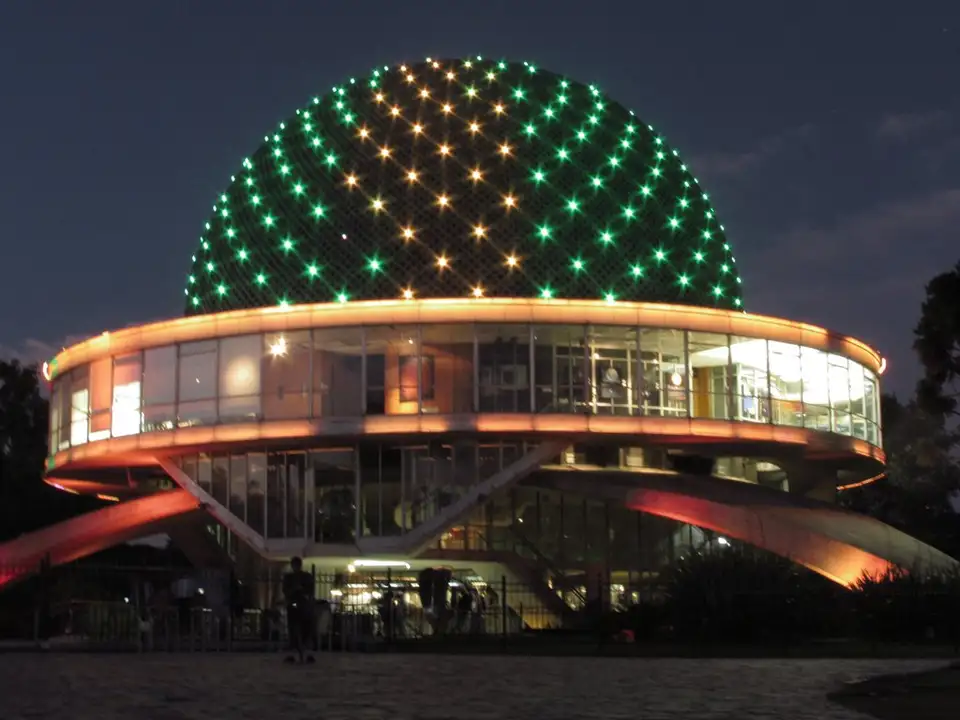
The building is a work by Argentine architect Enrique Jan, whose construction began in 1962. Its design is not merely aesthetic but responds to a precise geometry: the structure rests on three large supports that represent the symbolic relationship between the circle, the triangle, and the square. This configuration accommodates a dome of considerable dimensions, designed specifically for the needs of astronomical observation.
Since its first show in 1967 and its official opening to the public in April 1968, the Planetario has served as a bridge between the advances of modern astronomy and the community. Over the decades, the center has undergone modernization processes to keep its technological content current.
Projection Technology and Visual Experience
The heart of the visit centers on its hemispherical projection hall, a space equipped with state-of-the-art technology to recreate the night sky. The current system is hybrid, combining optical and digital elements to offer an immersive experience. It features a Megastar-IIA-Kaisei optical projector of Japanese origin, capable of displaying stars at a magnitude that emulates real visibility under conditions of absolute darkness.
This optical precision is complemented by the Sky-Skan Definiti digital system, which reaches 6K resolution, ensuring sharpness in images of the solar system and other celestial bodies. The incorporation of state-of-the-art Barco projectors allows not only for improved internal projection quality, but also for mapping interventions on the building’s exterior facade, integrating technology with the urban environment.
To add a sensory dimension to the visual experience, the hall features 4D seats that incorporate physical sensations during projections. This combination of high digital resolution and tactile elements aims to deepen the viewer’s connection to the spatial phenomena presented on screen.
Setting in Parque Tres de Febrero
The Planetario does not function as an isolated element but is a fundamental part of Palermo’s cultural and recreational dynamic. Its presence in Parque Tres de Febrero connects it to a network of green and cultural spaces that define the identity of the area. The structure, with its form evoking a flying saucer, acts as a visual landmark that orients visitors within the extensive grounds of the bosques, consolidating its role as a space where scientific knowledge meets outdoor leisure.